
Popular games for platform Legacy Computer
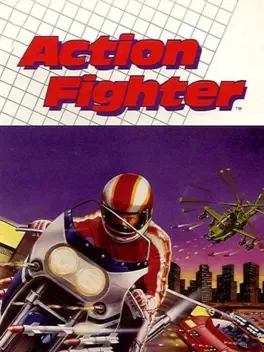
Take to the streets or take to the skies. Because Action Fighter is the incredible, transformable combat vehicle. You start out on a customized cycle. Built with enough speed and power to jump over water and overtake enemies. Then, by finding the right parts along the way, you'll change your cycle into a supercharged, state-of-the-art sports car. Next, add two turbojets to make your car airborne. And take to the skies. Down hyped-up helicopters and jet spaceships from above. And no matter which vehicle you're manning- or who you're after- get ready to stand by for action!
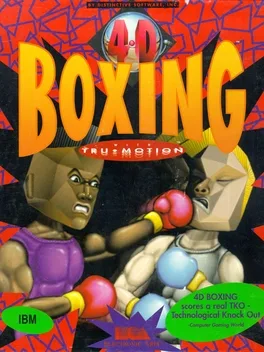
4-D Boxing leaves behind any pretences of being a pure arcade game based on boxing, and aims to recreate the sport in full detail. The graphics engine allows for multiple camera angles and viewpoints, and considerably detailed visuals. These required more advanced hardware than was common at the time, but a stick-figure mode was included as a compromise. The moves on offer include all the uppercuts and hooks of a real fight, and the players are designed to move realistically to implement them. You progress through the game by taking on a succession of increasingly difficult fighters, and get to train your boxer in between. Advanced action replays are included as well, so you can review all that happened.

It has all the features, flexibility, art, animation, and power you need to create an environment of your dreams. Choose from a selection of bonus cities and scenarios to rule or ruin as you please. Build schools, libraries, hospitals, zoos, prisons, power plants, and much more... Lay down roads, railways, and highways. Explore the underground layer and build subways and utilities without compromising your aesthetics. Customize different buildings or design your own graphics sets from scratch. This is the ultimate classic Maxis city-building and management simulation. If this game were any more realistic, it'd be illegal to turn it off!
The original version of Tetris was created by Alexey Pajitnov for the Elektronika-60 computer. It was never released commercially. It was also playable on the successor DVK-1 and DVK-2 computers, although it is unknown whether that is a different version, or simply the same code running on a different computer. Minor visual differences are present, but the gameplay is the exact same.
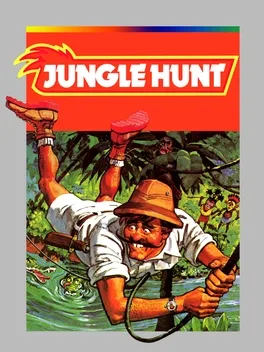
Jungle Hunt is side-scrolling arcade game produced and released by Taito in 1982. It was initially released as Jungle King. Jungle Hunt is one of the first video games to use parallax scrolling. The player controls an unnamed jungle explorer sporting a pith helmet and a safari suit. The player attempts to rescue his girl from a tribe of hungry cannibals by swinging from vine to vine, swimming a crocodile-infested river, jumping over or ducking beneath rolling rocks, then releasing the girl before she is lowered into a boiling cauldron. Home versions were released for the Apple II, Atari 2600, Atari 5200, Atari 8-bit family, Commodore 64, ColecoVision, VIC-20, and IBM PC. The PC version was developed by Sierra On-Line and is incompatible with everything except an original IBM PC/XT with a CGA video card. In the Atari-ported versions the hero is named Sir Dudley, and the girl, married to Sir Dudley, is Lady Penelope.
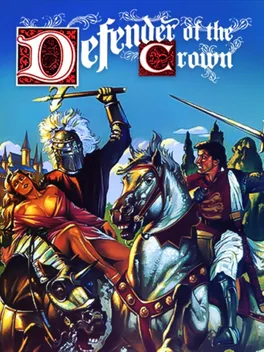
The Age of Chivalry! A time of lusty wenches and black hearted villains. King Richard has been murdered and England is thrown into civil war! Amidst the ringing clash of steel and the thunder of charging steeds the bold Saxon knights have chosen you to lead them into battle against the hated Normans. Victory will not come easy. To save England your skills as swordsman and military leader will be severely tested. But should you succeed you’ll win the Crown of England and the love of many a beautiful damsel!
Despite the defeat of Trebor, Werdna, and L'kbreth, dark times once again threaten the kingdom of Llylgamyn. So once again a party of adventurers must venture forth to vanquish the evil. Wizardry V represents a complete revision of the gaming system used in the first four installments, with larger mazes, new spells and character classes, and an expanded system for combatting and interacting with creatures. It is also the first game in the series that allows, but does not require characters imported from a previous scenario.
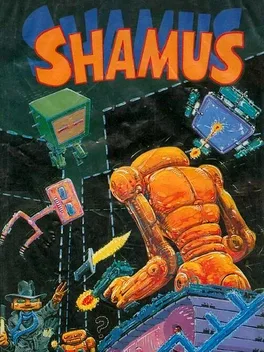
Shamus is a shooter with light action-adventure game elements written by Cathryn Mataga and published by Synapse Software. The original Atari 8-bit computer version was released on disk and tape in 1982. According to Synapse co-founder Ihor Wolosenko, Shamus made the company famous by giving it a reputation for quality. "Funeral March of a Marionette", the theme song from Alfred Hitchcock Presents, plays on the title screen.
Star Trek is a text-based strategy video game based on the Star Trek television series (1966–69) and originally released in 1971. In the game, the player commands the USS Enterprise on a mission to hunt down and destroy an invading fleet of Klingon warships. The player travels through the 64 quadrants of the galaxy to attack enemy ships with phasers and photon torpedoes in turn-based battles and refuel at starbases. The goal is to eliminate all enemies within a random time limit.

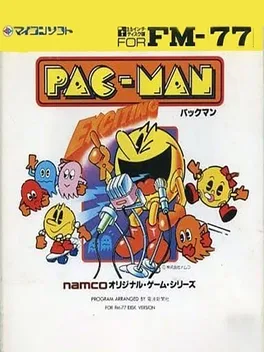
A port of Pac-Man for the FM-77 computer.

This is the game that put System 3 on the map. First unveiled at the PCW Show in 1985. Epyx licensed the game in the US as World Karate Championship and it became the first UK product to get a US billboard No.1. It even won a CES Showcase award.
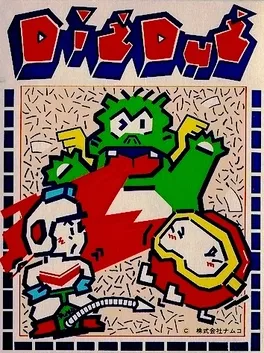
Sord M5 port of Dig Dug.
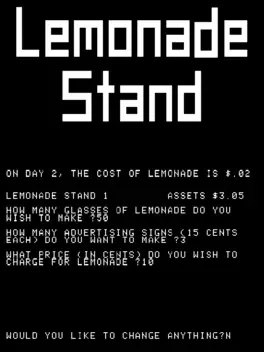
Lemonade Stand is a business simulation game created in 1973 by Bob Jamison of the Minnesota Educational Computing Consortium. Charlie Kellner ported the game to the Apple II platform in February 1979. Throughout the 1980s Apple Computer included Lemonade Stand (along with other software) with the purchase of their systems. The game simulates a child's lemonade stand, where choices made by the player regarding prices, advertising, etc. will determine the success or failure of the enterprise. The game owed its success to offering just enough variables to make a complex challenge for users, but still providing a simply-grasped addictive introduction to the offsetting priorities facing a business. The choice of the right prices and quantities on the day of a heat-wave could instill the satisfaction unique to a greatly profitable private enterprise. The player is first given a weather report for the day (sunny, cloudy or hot and dry, each accompanied by a color drawing) and is prompted for three values: the number of glasses of lemonade to make, the number of advertising signs, and the cost of lemonade per glass. The program then gives a report of the earnings for that day. A thunderstorm, sometimes occurring on cloudy days and accompanied by a color animation, will void any profits and cause the player to lose any investment for the day. The game can be played either single-player or with up to 30 players (each player is independent and the sales of one do not affect another). The Apple II version included music, with bars from "Morning Mood," "Singin' in the Rain," "Raindrops Keep Fallin' on My Head," and "Summertime" played at appropriate moments.

The first known game incorporating graphics that updated in real time, rather than only when the player made a move, was a simulation of a bouncing ball created by Massachusetts Institute of Technology (MIT) student Oliver Aberth for the Whirlwind I computer. He began creating the simulation in February 1951, before the computer was completed in April. It allowed users to adjust the frequency of the bounces with a knob, and sometime between late 1951 and 1953 he made it into a game by adding a hole in the floor for players to aim for.
Mugwump is an early video game where the user is tasked with finding four "Mugwumps" that are randomly hidden on a 10x10 grid. It is a text-based game written in BASIC. The user enters a pair of single-digit co-ordinates in the range from 0 to 9 which are the x,y coordinates to scan. If a mugwump is at that location then the user is alerted. Otherwise the user is told the distance from the scanned coordinates to each of the mugwumps that are yet to be found. The game ends after ten turns or when all of the mugwumps have been found.
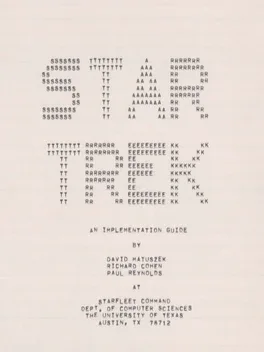
A version of Star Trek ported by Dave Matuszek, Paul Reynolds and Richard Cohen for the CDC 6400/6600 computer systems at the University of Texas. Unlike the version published by David Ahl in BASIC, this version was written independently in FORTRAN, however many of the changes in this version would go on to influence subsequent versions along side the more accessible version found in Ahl's book.
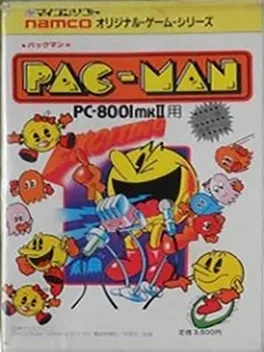
A port of Pac-Man for the NEC PC-8000.
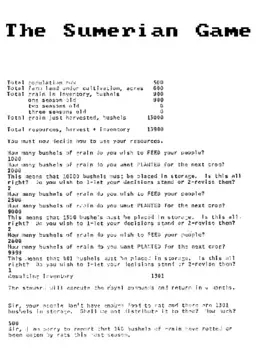
The Sumerian Game is a text-based strategy video game of land and resource management. It was developed as part of a joint research project between the Board of Cooperative Educational Services of Westchester County, New York and IBM in 1964–1966 for investigation of the use of computer-based simulations in schools. It was designed by Mabel Addis, then a fourth-grade teacher, and programmed by William McKay for the IBM 7090 time-shared mainframe computer. The Sumerian Game has been described as the first video game with a narrative, as well as the first edutainment game. As a result, Mabel Addis has been called the first female video game designer and the first writer for a video game.
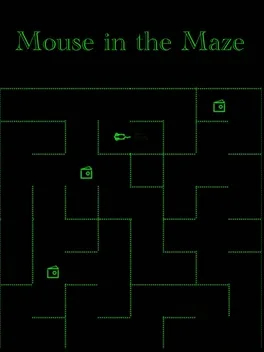
A game where players place maze walls, bits of cheese, and (in some versions) martini glasses by way of a light pen interacting with the screen.
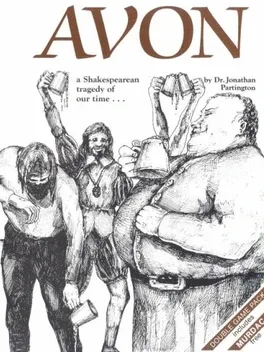
An Interactive Fiction adventure by Jon Thackray and Dr. Jonathan Partington for the IBM System/370 'Phoenix' mainframe system at the University of Cambridge.
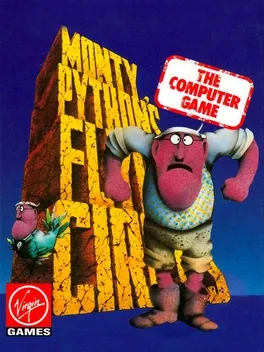
You control Mr. D.P Gumby and, understandably, you have to get back his 4 pieces of brain. This is not easy. If it was, this game would not be a game of skill and fun, now would it? There are four skill levels to this game, a piece of brain is being held on each skill and fun level. The levels are all quite different in a skill and fun sort of way, but all have different things in common. Good things like sausages, eggs, beans, spam (skill) and cheese (fun) and bad things like dead parrots. Because each level is quite different in a skill and fun sort of way, Mr. Gumby cannot always walk, so, his body is changed to suit the surroundings. Like on the first level, where he is changed into a fish to swim in the maze like underwater caverns. When each level runs out there is no more, Mr. Gumby is changed back to normal (well normal for him) and he is sick, all the good things picked up along the way go in a big hole and are counted for points. Best of all though if you got 16 lots of spam Mr. Gumby can have a piece of his brain back. Then you have to do it all again.

One on One: Dr. J vs Larry Bird features basketball legends Julius Erving and Larry Bird competing in head-to-head matchups at a single basket court. Players can engage in timed matches or play to a target score, utilizing offensive moves like rotations, jump shots, and slam dunks, while defending through steals and blocks. The game includes signature moves from both athletes, slow-motion replays of notable plays, and a unique feature where players can shatter the backboard - prompting a frustrated janitor to clean up the debris before play can resume.
WAR was a two-player strategy game for the CDC-6600, created in the mid 1970's at the University of Texas at Austin.