
Drop Off



Buy
Could be interesting
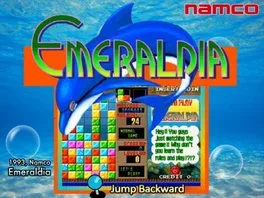
Emeraldia is a puzzle arcade game released by Namco in 1993 only in Japan.
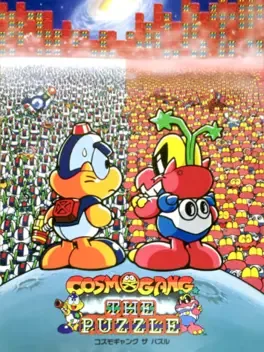
Cosmo Gang the Puzzle, a puzzle game which is similar to Tetris, and became the basis for Pac-Attack.
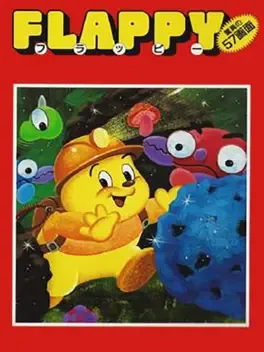
Flappy is a puzzle game by in the same vein as the Eggerland series and Sokoban that is obscure outside Japan. It features Flappy, a somewhat mole-like character who must complete each level by pushing a blue stone from its starting place to the blue tile destination.
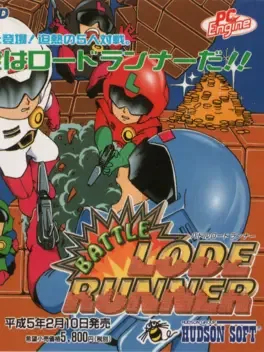
Once an ancient arcade game, and with a previous version on the PC Engine by Pack In Video, Hudson Soft have taken the addictive gameplay of Lode Runner and given the graphics a complete face lift. The puzzle-based action in Lode Runner is simple: You are presented with a side-view platforms-and-ladders based level and you have to collect all the gold and escape without getting caught by the baddies. To defend yourself, you can dig holes in the ground, either to the left or to the right, and enemies stumbling upon them will fall down and be trapped. If you time it right, the hole will re-fill before the enemy can climb out, forcing them to respawn elsewhere in the level. If you prefer evasive action, make sure the coast is clear so you can escape up a ladder or across a well-placed rope, but be warned - they will follow! Once you have collected all the gold, hotfoot it to the nearest long ladder and escape out the top of the screen. In magazine previews, this was originally titled Lode Runner II.
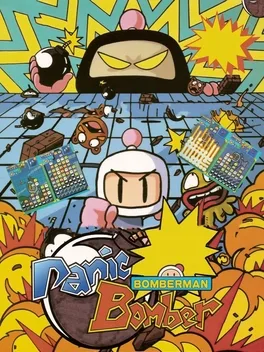
It is a "falling blocks" puzzle game based on the Bomberman franchise. The goal of the game is essentially to cause your opponent to lose by causing their gameplay field to fill to the top with objects. You do this by causing chains of bombs to explode, sending useless rubble over to your opponent's field, which they must then remove themselves. Bombs are earned by causing chains of three identical blocks to disappear. Bombs can only be blown up with an explosion from a lit bomb, which falls from the top of the screen every so often. If the player causes enough damage, they can eventually earn a giant bomb, which will remove a large amount of debris from the playing field, and cause their opponent a good deal of trouble. The game's regular story mode revolves around Bomberman's hunt for the Golden Bomber statue. During his trek, he fights against several different odd characters, like Drifty the balloon, or Cecil the tiger. However, all that can really be earned from playing through this mode is a harder difficulty level, earned by finishing the entire story at the "hard" difficulty level.
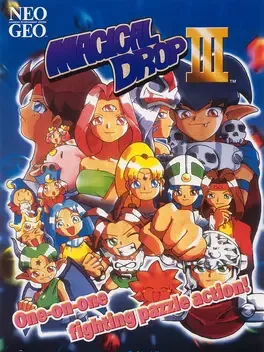
Control a clown to pull in and throw back balloons hurled from the top of the screen. If you line up three or more balloons of the same color in a vertical row, they will burst. If you're not quick enough, the balloons will squash the clown and the game is over. Once you've got the hang of bursting balloons, you'll need to master combos and chains. The third Magical Drop game, first released in 1997, was also developed for the Neo Geo. This games adds representatives for the remaining Tarot Major Arcana, as well as introducing a "daughter" Strength character that more closely resembles the traditional depiction of Strength. The game adds a third button, which allows players to add rows to their field at any time. Additionally, attacks now sends lines to the opponent in non-even rows that vary by character. Hirameki mode is replaced by Adventure Mode, which is a board game that challenges players to reach Empress before CPU-controlled rivals. The English versions of Magical Drop III remove the hardest difficulty setting in Vs. CPU Mode and rival opponents in Adventure Mode.
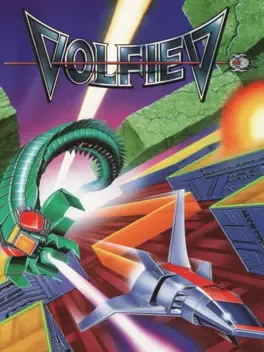
Once in the game, using the arrow keys you can move the 'Scanner' ship around the 'Shield Line' at the parameter of the playing area. While moving around this edge the ship is protected from the aliens by a shield indicated by a glowing circle around the ship. This shield is not infinite and care should be taken to complete each level as quickly as possible. A counter indicates the level of shield that you have: when it reaches zero then any contact with an alien is deadly whether you are on the 'Shield Line' or not. The idea of the game is to cut areas out of the screen without touching any of the aliens. This is done by pressing the SPACE key which initiates the 'Laser Cutter' and moving off the 'Shield Line' and rejoining it somewhere else. While you are in the process of drawing a line, your shield is inactive and touching an alien is fatal. Similarly, if one of the aliens touches the line then it will send a charge down the line towards you and you must quickly return to the safety of the edge before it reaches you. When you rejoin the 'Shield Line' the area that does not contain the 'Boss' alien will be filled (points are gained by trapping the other aliens) and the 'Shield Line' will be adjusted to surround the area that is left. The level is completed when a certain percentage of the total area has been filled in. This percentage starts at 80% but may increase in the later levels.
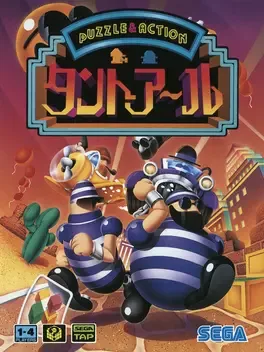
Puzzle & Action: Tant-R is a Sega System C puzzle game developed and published by Sega. It is the first in Puzzle & Action series, and has subsequently been ported to the Sega Mega Drive and Sega Game Gear. Though the arcade version of Tant-R reached South Korea, the Mega Drive version remained exclusive to Japan and no versions of the game have ever made it to North America or Europe. Tant-R borrows its graphical style from Bonanza Bros., and is therefore often seen as a spin-off. The two were paired with the game's sequel, Puzzle & Action: Ichidant-R in volume 6 of the Sega Ages 2500 series for the PlayStation 2. Tant-R was also paired with Quiz Shukudai wo Wasuremashita for a compilation on the Sega Saturn. A spinoff Saturn game – Sega Ages Vol.1 Shukudai ga Tant-R – was also made.
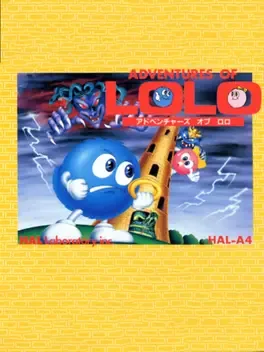
This game is different from the Western game Adventures of Lolo, being the sixth game in the Eggerland series.
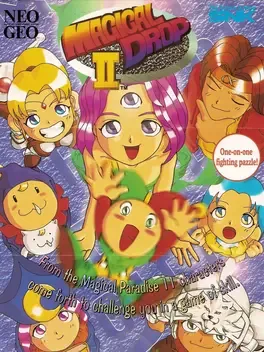
Magical Drop is played in a style and gameplay similar to Compile's (now Sega's) Puyo Puyo and Taito's Puzzle Bobble franchises; a "stack" of random colored bubbles descend from the top, and a player is defeated when a bubble hits the bottom. Bubbles can be picked up and dropped by the player's "clown" at the bottom, and are destroyed when three or more of the same color are put together on a single column. "Chains" are formed either when a single drop caused a chain reaction, or when more than one group of bubbles is destroyed in quick succession. The game is normally played with two players (one may be a computer opponent), and chains cause the opponent's stack to descend faster. There are 24 characters, all but the Black Pierrot being named after a tarot card (although the Strength card has been represented by two characters throughout the series). Different characters have different attack patterns. The columns of the opponent's stack will descend at different rates relative to each other depending on the character chosen. This causes a disjunction of colors that may make it more difficult for the other player to clear their stack. For example, with the character Devil, all the columns will descend at the same rate, whereas with Sun, the middle columns will descend faster than the others.