
Popular games for platform PC-8800 Series
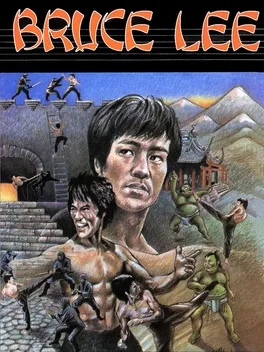
Bruce Lee is a video game designed by Ron J. Fortier, with graphics by Kelly Day and music by John A. Fitzpatrick. It was originally developed for the Atari 8-bit family and published in 1984 by Datasoft, along with a port for the Commodore 64. The game was converted to the ZX Spectrum and Amstrad CPC and published by U.S. Gold in the same year. An MSX version was published in 1985 by Comptiq. Bruce Lee is a platform game/beat 'em up hybrid, in which the player controls Bruce Lee.
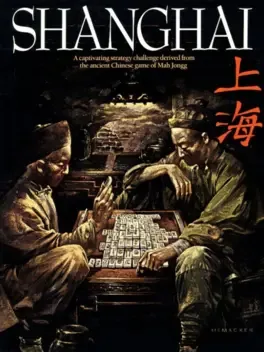
Shanghai is a computerized version of mahjong solitaire. After winning a game, the tiles reveal the three-dimensional blinking eye of a dragon behind the game screen. The Macintosh and Sega Master System version shows an animated dragon spitting fire.
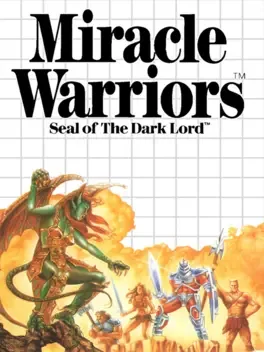
Japanese RPG. Two editions exist, one for the MSX1 on cartridge, and one for the MSX2 on 3.5" diskette. The seal of the Dark Lord Terarin has been broken and Terarin has been unleashed into the world again. She has stolen the Golden Seal and opened pandora's box, unleashing evil creatures into the world. A young hero is tasked by a king to stop Terarin. He must step into footsteps of Iason, a shepherd that once accidentally unleashed Terarin and fought to seal the Dark Lord again. The hero must enlist the aid of three companions, Guy the warrior, Medi the amazon and Treo the pirate (called Turo in the manual) and find the three keys to Terarin's lair. To face the Dark Lord, they must find the mystical weapons and armor of old and then defeat Terarin and seal the Dark Lord from the world.
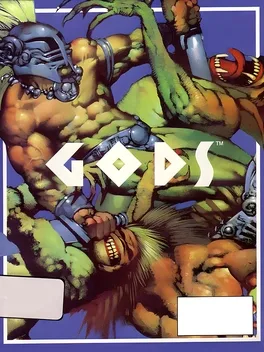
Who would have thought that a man would be so foolish or so daring as to accept a challenge set down by the Gods? And yet one came forward to claim the right to test his skills and strengths against a city so legendary its name alone struck fear in the hearts of all who heard it spoken.
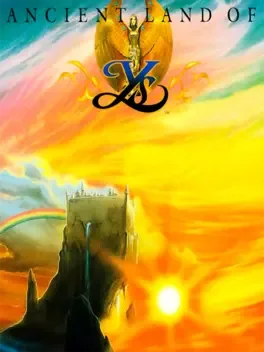
The hero of Ys is an adventurous young swordsman named Adol Christin. As the story begins, he has just arrived at the Town of Minea, in the land of Esteria. He is called upon by Sara, a fortuneteller, who tells him of a great evil that is sweeping the land. Adol is informed that he must seek out the six Books of Ys. These books contain the history of the ancient land of Ys, and will give him the knowledge he needs to defeat the evil forces. Sara gives Adol a crystal for identification and instructs him to find her aunt in Zepik Village, who holds the key to retrieving one of the Books. With that, his quest begins.
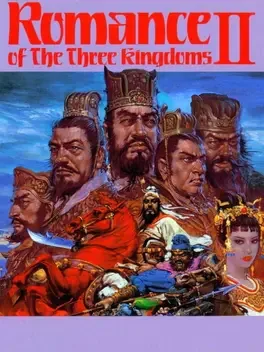
The player takes control of a master, a general capable of commanding as many states as he can acquire, and, if successful, unifies China. As many as eight may play, but only one can succeed. There are five chronologically arranged scenarios. The first has China in its most disorganized period and the last has virtually all of China controlled by one of three generals. The precise requirements for success in each of these scenarios differs, but in all cases the goal is to rule as many states as possible. After the completion of any scenario but number five the game will automatically advance to the next. You may start the game at any scenario.
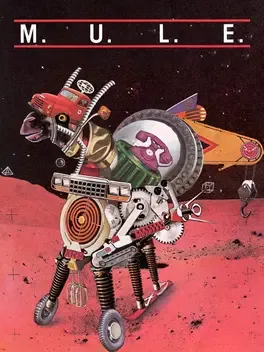
M.U.L.E. is about four hopeful explorers trying to make a fortune on a virgin planet. This is done by producing various goods (Food, Energy, Smithore, Crystite). Each of these goods have their uses: if you don't have enough food, you will have less time during your turn. If you don't have enough energy, your output will be lower. If enough smithore isn't produced, there will be a shortage of M.U.L.E.s. Crystite is the big earner that can make or break your game. You start the game by selecting your race. Some are easier to play, some harder. There are three levels of difficulty, in the easiest the game only lasts 6 turns, but the real game is 12 turns. Crystite is not available at the easiest level. Each turn starts with land claim. Each player gets to choose a spot of land for themselves from the map. If two players choose the same spot, the player with less money wins. The map consists of different landscape. River is best for producing food, plains for energy, mountains for smithore. Crystite is hidden and must be first found by taking a land sample to the town. After the land claim each player takes turns in cultivating their land and do other tasks. They can buy M.U.L.E.s to start production on their land, sabotage other players by buying M.U.L.E.s and letting them loose, try to catch the Wumpus for cash and try to find crystite veins. The time to do these things depends on if the player has enough food. Finally the player goes to the casino and wins a small amount of money, depending on how much time was left.

Adol Christin's long-time friend, Dogi, wishes to return to his home town of Redmont after hearing about strange disturbances that are happening there. Always looking for an adventure, Adol joins him and soon finds out the cause of this new evil. Ys: Wanderers from Ys breaks away from the "bumping into enemies" battle system of the first two games, allowing Adol to control his sword in a variety of directions. Beside changing the battle system, the game's perspective switches to a side-scrolling view, as opposed to the top-down one of the previous games. Adol also has the ability to jump now. New to the series is the use of magical rings, which give Adol different powering-up abilities such as healing and shielding. The game also uses various key items found along the way to solve minor puzzles and progress the story.
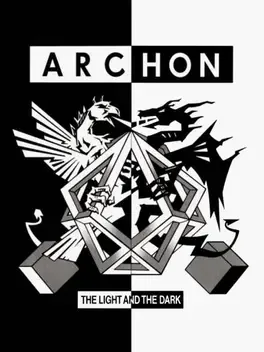
Archon: The Light and the Dark was a game developed by Free Fall Associates which loosely modeled the game of Chess, with a number of additions to the gameplay. It was programmed by Anne Westfall, and released originally for Atari 8-bit computers in 1983. It was quickly ported to a number of different systems, and was well-received.

Déjà Vu is a point-and-click adventure game that draws inspiration from "noir" detective novels that were popular in the 1940s.
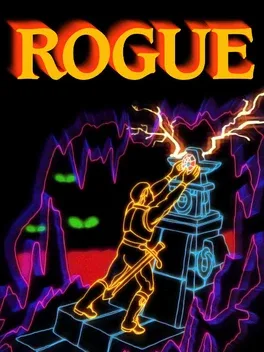
Rogue is a dungeon crawling video game first developed by Michael Toy and Glenn Wichman around 1980. It was a favorite on college Unix systems in the early to mid-1980s, in part due to the procedural generation of game content.
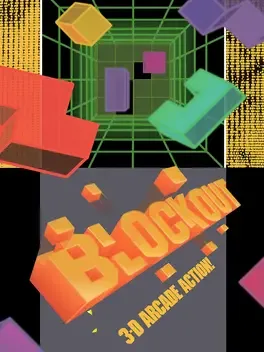
Blockout is a puzzle videogame, created in 1989 by Polish developer - California Dreams, designed by Aleksander Ustaszewski and Mirosław Zabłocki. The game is the logical extension of Tetris into the third dimension. In Tetris, the player manipulates a set of tetrominoes which fall into a two-dimensional pit (seen from the side). The aim is to solve a real-time packing problem by forming complete rows, which then disappear and score points. Poor play leads to incomplete rows, caused by inefficient arrangements of tiles; these rows do not disappear, giving the player progressively less space and less time to play subsequent pieces. Similarly, in Blockout, the player manipulates a set of polycubes which fall into a three-dimensional pit (seen from above; the pieces appear in the foreground and fall away). The pieces can be rotated around all three axes, and moved horizontally and vertically. The aim is to form complete layers.
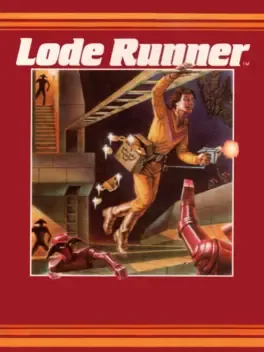
Lode Runner is a 1983 puzzle video game, first published by Brøderbund. It is one of the first games to include a level editor, a feature that allows players to create their own levels for the game. This feature bolstered the game's popularity, as magazines such as Computer Gaming World held contests to see who could build the best level.

BurgerTime is a 1982 arcade game created by Data East for its DECO Cassette System. The game's original title, Hamburger, was changed to BurgerTime before its introduction to the US. The player is chef Peter Pepper, who must walk over hamburger ingredients located across a maze of platforms while avoiding pursuing characters. The game was popular in arcades. In the US, Data East USA licensed BurgerTime for distribution by Bally Midway. The Data East and Midway versions are distinguished by the manufacturer's name on the title screen and by the marquee and cabinet artworks.
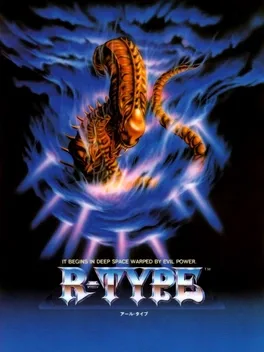
R-Type is set in the 22nd century, and the player flies a futuristic fighter craft called the R-9a "Arrowhead", named for its shape, and because it is the ninth model in the 'R' series of fighter craft (but it is the first of the series to actually be used in combat; the previous models were all prototypes). The mission is to 'blast off and strike the evil Bydo Empire'. The R- in the series title originally stood for "ray", as in a ray of light. It was a reference to the many different types of ray-like weapons in the first R-Type. his was later retconned in R-Type Final to refer specifically to the production code as well as a term of endearment for the player fighter craft, the "Round Canopy". The original R-Type was well received by most gaming critics. However, it was also infamous for its relentless difficulty. It earned 7th place in IGN's Top 10 most difficult games to beat. The gameplay of R-Type is noticeably distinct among shoot 'em ups. Invariably the player will lose, not because of an inequality in firepower, but because of the design of the levels themselves. There is usually a 'correct' way to get through a level, but players must learn these by experience - i.e. by losing and restarting from earlier in the level. The game innovated with its weapon system compared to contemporary shooters, featuring a chargeable shot (beam-meter), and detachable 'force' pod; levels were designed to require different tactics and ideal weapons (air-air, diagonal, or air-ground laser).

Tennis is a sports game developed and released by Nintendo for the NES. In North America and Europe, Tennis was one of 18 launch games for the NES. A Game Boy version was also released. The game features single-player and two-player modes for singles and doubles matches, with either competitive or cooperative gameplay. A computerized opponent's artificial intelligence can be set to one of five difficulty levels. Mario referees the matches.
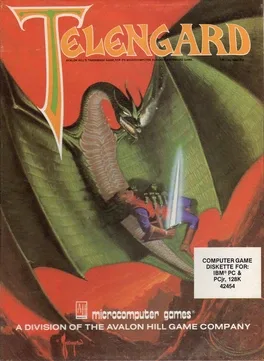
Telengard is an earlier example of a "dungeon crawler" role-playing game--albeit with a top-down view- with either real time movement (DOS version) or turn-based movement and turn based combat. Telengard is also played in real time, which means that monsters can attack even when the player's character is not moving. The player controls a single adventurer, selecting randomly-rolled sets of attributes: Strength, Intelligence, Wisdom, Constitution, Dexterity, and Charisma. The vast Telengard dungeon consists of 50 levels down and 200 by 200 rooms each level. Experience is awarded not only for defeating enemies, but also for finding treasure. When the player character gains a level, their attributes increase, and they gain the ability to cast higher-leveled spells. Treasure chests appear randomly in the dungeon. There are also specific features such as altars, thrones, fountains, etc. that the adventurer can discover which may have various effects on the character, whether being either positive or negative. Some creatures will befriend the player, sometimes providing the player with an item and/or healing them, provided the player's Charisma is high enough.
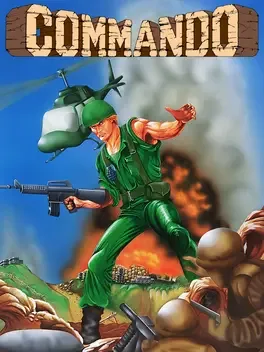
Several levels await your super-tough Commando in this arcade conversion. Armed with only a standard rifle and a few grenades you must take on hordes of enemies. Some are wandering around in the open, while others have picked out hiding places, which you must approach from certain angles. Trees, rivers and bridges create a varied combat-like terrain and must be incorporated into your thinking. Extra grenades can be collected, and will definitely be required, as they allow you to kill from distance and thus avoid some enemy shots.
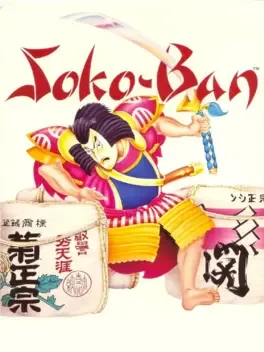
Sokoban ("warehouse keeper") is a is a classic puzzle game created in 1981 by Hiroyuki Imabayashi, and published in 1982 by Thinking Rabbit, a software house based in Takarazuka, Japan. In 1984 the ASCII Corporation published a version produced by Khaled Bentebal. It was the basis of numerous clones in the later years. It is set in a warehouse. On each level, the player must push crates (from square to square) to get them onto designated spots; once each crate is on a marked spot, the level is complete. Crates can only be pushed one at a time (so two crates next to each other cannot be pushed together), and cannot be pulled--so it's possible to get a crate stuck in a corner, where it cannot be retrieved! By the last levels, you must plan 40 steps in advance.
A bright light shot up from Darm Tower in the end of the first Ys, and Adol Christin is awakened by a young girl who finds him lying on the ground. She introduces herself as Lilia and tells Adol he is in the land of Ys. Finally he was able to establish a connection between his world and this mysterious land! But finding the gateway to Ys is not enough: Adol must stop an evil entity that his archenemy Dark Fact served. And his foes already know where he is. Ys II: Ancient Ys Vanished - The Final Chapter is a direct sequel to Ys I: Ancient Ys Vanished - Omen. The game continues to utilize the action role-playing combat style of the first installment, which requires the player to make the protagonist run into the enemy in order to cause damage, without the need to press an attack button. The player should choose the angles and the measure of contact with the enemy carefully, otherwise the hero will be killed. The player character can (and should) level up, perform quests for village people, gather money, and upgrade weapons and inventory, like in most other RPGs. The sequel offers a longer quest than the first installment, and adds a magic arsenal to Adol's abilities. Among the magic spells is a fire attack, a time-stopping spell, and a transformation ability that allows Adol to pass for a monster and converse with enemies. Magic spells deplete Adol's magic points bar.
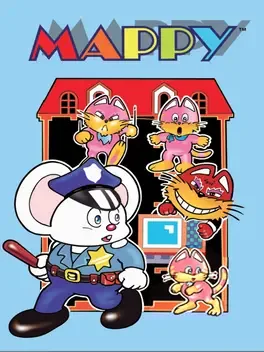
The player guides Mappy the police mouse through the mansion of the cats called Mewkies (Meowky in the U.S. version) to retrieve stolen goods. The player uses a left-right joystick to move Mappy and a single button to operate doors. The mansion has six floors of hallways in which the stolen items are stashed.
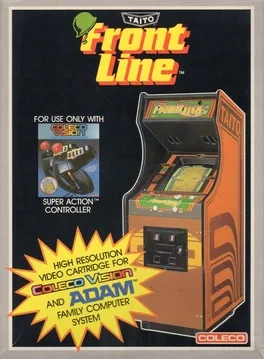
Front Line is a vertically scrolling action game. Your mission is to infiltrate enemy territory and destroy their fortress. To reach the fortress, you will have to make your way through varied and dangerous terrain. Jungles, deserts, brush, and rocks all slow your progress, plus each area has numerous enemy fighters and tanks trying to stop you. To help get past these obstacles, you are armed with a machine gun and grenades; at some points in the game you may even come across an abandoned tank which you can control to increase your odds of survival. When you reach the end of the level and successfully destroy the fortress, the game will repeat at a higher level of difficulty. Gameplay is for one or two players, and four different skill levels are available.
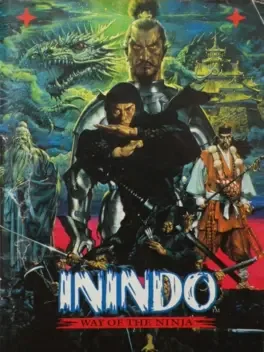
"Inindo: Way of the Ninja" is a console-style RPG with a touch of strategy. You navigate your hero on the world map, visit towns, and descend into dungeons. The battles are turn-based and are viewed from a third-person perspective, like in Final Fantasy games. You can move on the battle field and use melee or long-ranged attacks. You'll be able to recruit characters of various classes to your party, who will join you for profit or for other reasons. After you gain enough experience, you'll also be able to talk to daimyos (feudal rulers) of various castles and to convince them to work together against Nobunaga. You can also perform various tasks for the daimyos, such as spying. 1581, Japan. Fearing a rebellion and striving to conquer the entire country, the warlock Nobunaga orders to attack the Iga ninja clan. The ninjas bravely defend their village, but, being vastly outnumbered, are mercilessly slain by Nobunaga's men. Only one survived: you, the hero of the game. Shortly before the assault you were sent to a nearby village to warn the elder of Nobunaga's attack. However, the other village is also destroyed by Nobunaga's army. You swear to avenge his crime. But for now, you are just an inexperienced young men, and are "wanted" by Nobunaga's men and ruthless bounty hunters. Will you be able to unite Japan in the ultimate struggle against Nobunaga?
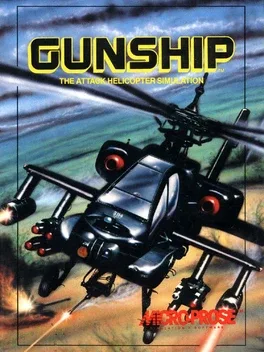
After selection of region, style, and enemies, the pilot is assigned a primary mission and a secondary mission. These could include such objectives as "Destroy enemy headquarters" or "Support friendly troops" (i.e. destroy targets near friendly forces). The latter would be an easier mission, because the battle would be fought closer to friendly lines.