
Popular games for platform Fairchild Channel F
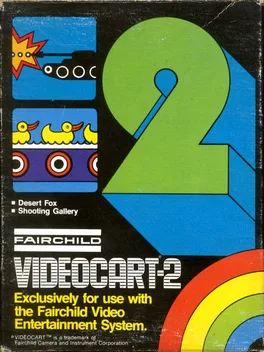
Videocart-2: Desert Fox &Shooting Gallery is action/shooter genre video game released in 1976 by Fairchild Semiconductor for the Fairchild Channel F. Stalk a foxy enemy or knock off a few ducks. Let out your hunter instincts with these two exciting games.
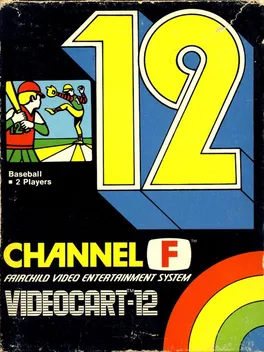
One player takes to the field, the other grabs a bat and steps up to the plate. The pitcher can throw fast, slow, and some wicked curves even at the last moment. Luckily the single-button swing action makes hitting the ball fairly easy, even if getting a single is harder than hitting a double or home-run. This preprogrammed cartridge plugs into the console of the Fairchild Video Entertainment System for more TV fun. Our Baseball game gives you nine (or more) innings to practice your timing, mix-up your pitches, shift your outfield... major league thrills with the comforts of home. (Tinkers to Evers never had such a Chance!)

3rees is a homebrew game which is an adaptation of 2048 with added extra rules. There are 3 game modes: 768 which is to acheive score of 768 as fast as possible, Long which is obtaining as high score as possible until maximum limit reached, and Time where you have 3 minutes to gain as much score as you can.
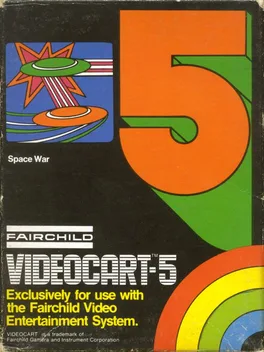
Videocart-5: Space War is a Shoot 'em up released by Fairchild Semiconductor for the Fairchild Channel F in 1977. This preprogrammed cartridge plugs into the console of the Fairchild Video Entertainment System for more TV fun. Teleport yourself and a friend to an interstellar battleground with this "faster - than - the - speed - of - light" game.
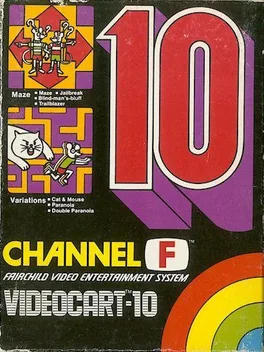
Poor little mice, doomed to run around in a maze and escape as quickly as they can. As if that's not enough, the owners of this maze pit you against a friend to see who will escape first. And then the diabolical owners take it one step further and add a cat to the maze mix - forcing you not only to escape first, but escape alive! In this Videocart Maze: A straight maze run. Jailbreak: The maze is a grid with hidden passages. Blind-man's-bluff: The maze is invisible and no walls can ever be seen. Trailblazer: The maze is invisible but the rats leave a trail on their path. There are also a few game modes: Regular Maze: Two players race each other out of the maze. Cat and Mouse: The computer controls a cat that chases the mice. There are 4 different speeds for the cat. Paranoia: Neither mouse can leave the maze until the other one is caught by the cat. Double Paranoia: There's no cat and neither mouse can leave the maze, allowing the players to practice or experiment play modes. This preprogrammed cartridge plugs into the console of the Fairchild Video Entertainment System for 52 variations of our TV Maze games. Regular Maze. Every mouse for himself. Cat & Mouse: Mice vs. hungry cat. Paranoia: Nobody out till the cat has lunch. Or Double Paranoia: Nobody out. Ever.
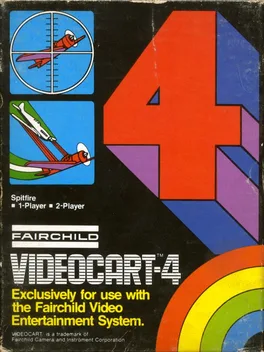
Videocart-4: Spitfire is a 1 on 1 aerial dogfighting Shooter game released by Fairchild Semiconductor for the Fairchild Channel F in 1977. In addition to a 2 player mode the game allowed for 1 player to combat the CPU, which for the time was unique for a home console thanks to the Channel F being the first home console with a CPU. This preprogrammed cartridge plugs into the console of the Fairchild Video Entertainment System for more TV fun. Join up and get ready for the toughest dogfights since the Great Air War in 1 and 2- player versions of Spitfire.
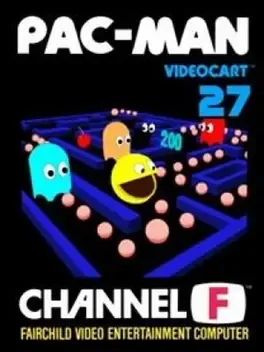
An unauthorized version of Pac-Man. Pac-Man is a game where the eponymous Pac-Man goes around a maze in the cardinal directions munching pellets as he goes. The goal is to eat all the pellets found on the maze. While trying to do this, Pac-Man is harassed by four ghosts (Blinky, Pinky, Inky, and Clyde) who constantly chase him around the maze. If the ghosts touch Pac-Man, he will lose a life. Pac-Man starts with three lives and if he loses all of them the game will end. Pac-Man is not completely defenseless as on each maze, there are four power pellets, that when Pac-Man consumes them, will cause the tides to turn, as Pac-Man will be able to temporarily chase the ghosts to eat them and temporarily send them back to the middle of the maze from whence they came. Pac-Man can also eat randomly appearing fruit to earn bonus points. This version of Pac-Man retains the intermissions found in the original game.
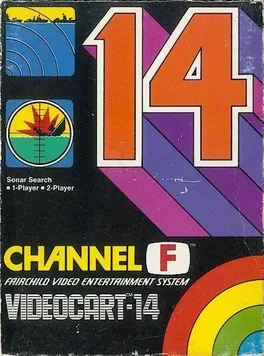
Sonar Search features the basic gameplay idea of Battleship, but with a unique twist. Instead of trying to randomly guess what grid an opponent's battleship is on, after the player takes a shot, the player will hear a sonar ping noise. The shorter the noise, the closer the player is to hitting a target. In the 1 player game, the player has a limited number of chances to sink the enemy fleet of ships, while in the 2 player game, players take turns trying to sink their opponents ships before having their own ships sunk. This preprogrammed cartridge plugs into the console of the Fairchild Video Entertainment System for more TV fun. This battle on the high seas is sure to score a direct hit with exciting one and two-player games.
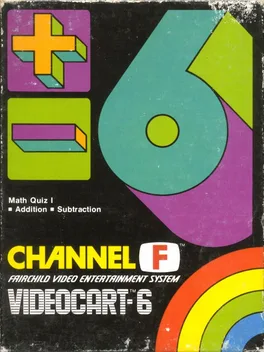
Videocart-6: Math Quiz (Addition & Subtraction) is a Triva/Game Show video game released by Fairchild Semiconductor for the Fairchild Channel F in 1977. This preprogrammed cartridge plugs into the console of the Fairchild Video Entertainment System for more TV fun. Get one problem right and a new one appears. Take turns with a buddy for added competition... Plus or minus some fast-paced fun.
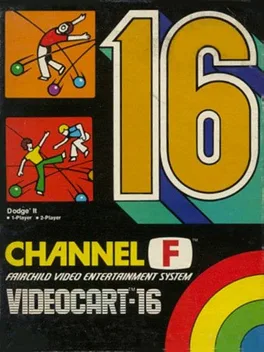
The gameplay featured on this cart is a take on the game of Dodgeball. The player is trapped inside a playfield and has to dodge a ball that continuously keeps bouncing of the sides of the playfield. The longer the player is able to dodge the ball, the more points are earned. After a certain amount of points are earned, another ball enters the playfield thus making the player have to dodge two balls. More balls keep getting added at fixed intervals after that until a total of 9 balls are in the playfield. The game ends when the player is finally hit by the ball. In the 2 player game, both players are put into the same playfield and try to outlast the other player in trying not to get hit by the balls being thrown by the computer. The game features random variations in the gameplay, such as having different sized playfields, ball sizes and speeds, and changing the players' size and speed. There's an Amateur and a Pro mode, both playable with either 1 or 2 players. This preprogrammed cartridge plugs into the console of the Fairchild Video Entertainment System for more TV fun. It's like the old playground favorite dodge ball. Only this time the computer's throwing the balls, not your classmates.

A port of the 1975 PC-50X Game Submarine, similar type games were also in the arcade and are ports themselves from Electromechanical games. Choose either the Submarine (Blue) or Destroyer (Green) and attempt to shoot each other with missiles. Submarine can also hit the Escort (Red) ship that is protected by the Destroyer. Plunging down the controller fires, Push Left / Right for Left and Right movement on screen respectively. Game ends when one side reaches 15 points.
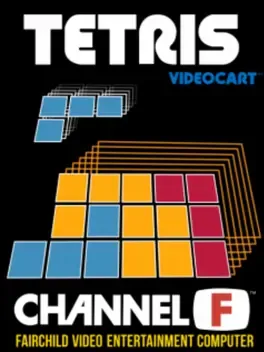
A one- or two player puzzle game published and developed in 2004. This is an unofficial homebrew of Tetris for the Fairchild Channel F.
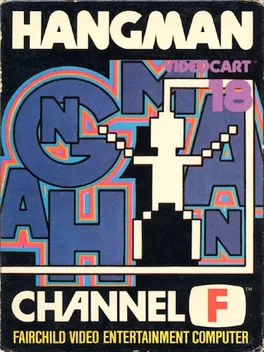
The classic game of Hangman, in which the player has to guess a hidden word by suggesting letters. Only a certain number of letters can be tried - every incorrect guess will add an element to a drawing of a man being hanged at the gallows. The player loses if the drawing gets complete, due to his missing attempts at finding the letters in the secret word. The game contains 64 game variations of this basic premise for either 1 or 2 players, with or without a score. Variations include: The computer selects the word to guess; One player comes up with a word for another player to solve; The player is given one of the letters in the word to help him get started; The game will tell the player he guessed the right letter but will not say where it belongs in a word; The player isn't told how long the secret word is; The player has to guess the letters and their location in the word; The player has to solve an anagram.
it's coming to the channel f. run for your lives. run to get this lovely new game. yes, get the runs. it's wackier than a whole can of worms. it's adventures of an anthropomorphic celery. mr. celery has a problem. A lot of them to be exact.
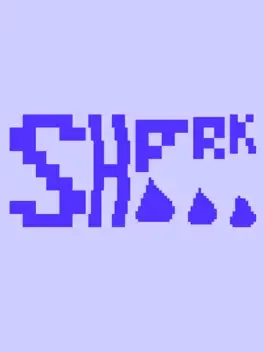
You play as the human character catching fish, while a shark attempts to eat you. Getting a fish scores you a point, the shark moves faster as you gain more points. Use directional buttons to move the diver, avoid the shark while collection fish. Push button down at highscore screen to start a new game.
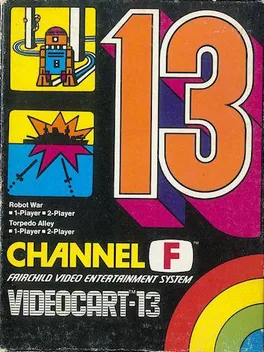
This cart contains two different games. The first game is Robot War. It takes place on a space station. The computer malfunctioned and now four robots are out to hunt down the player. Gameplay mainly has the player trying to trick the pursuing robots into one of the four electrified force fields littered throughout the playfield. Every time the player is touched by a robot, one of the force fields disappear. Once all the force fields disappear, the player loses a point to the robots. If all the robots are defeated, the player gets a point for that round. The game also features an option for two players, where the second player takes control of the robots. The game features four game speeds from slowest to fastest The other game is Torpedo Alley. Players control a shore battery at the bottom of the screen and shoot at an invading fleet of ships above them. Each hit ship is worth a different amount of points, with the lowest ship being worth 1 point, the middle ship worth 3 points, and the highest ship worth 5 points. The game ends when a player reaches 99 points or the adjustable time limit expires. This preprogrammed cartridge plugs into the console of the Fairchild Video Entertainment System for more TV fun. The hunter or the hunted. Take your choice in these action-packed one and two-player games.
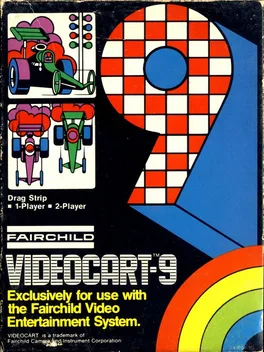
This drag racing simulator makes use of the Channel F's special controllers. While twisting the joystick's head to the left or right controls the engine throttle, the stick movement itself is used to shift gears in a realistic H-pattern. Depending on the chosen skill level, the car available is a family sedan, a modified sedan, a funny car, or a real dragster, although they all look the same on screen. One player can try to beat the predefined par time of 7.7 seconds, or compete against a friend to see who reaches the finish line first. The game manual mentions that a player only wins the game when he brings his victory counter to 99. This preprogrammed cartridge plugs into the console of the Fairchild Video Entertainment System for more TV fun. Know when to shift and you'll go the distance with these 2 racy games. But careful... Redline your engine, an dyou wind up shiftless! (You've blown it!)
Videocart-51: Demo 1
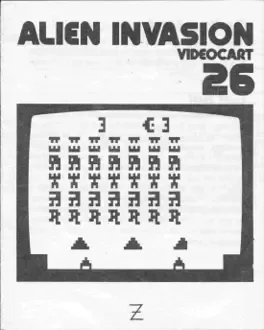
In this Space Invaders variant, the player controls a gun turret at the bottom of the screen and fires missiles at incoming alien ships. The turret can move both left and right and hide behind three protective barriers. The alien invaders move left and right, fire missiles at the player, and slowly approach the planet surface - if they land, the player loses the game. Every once in a while, an alien mothership will fly across the top of the screen and shooting it will give the player extra points. The goal of the game is to destroy all alien ships in each attacking wave and score as many points as possible. The game ends when players lose their three lives.
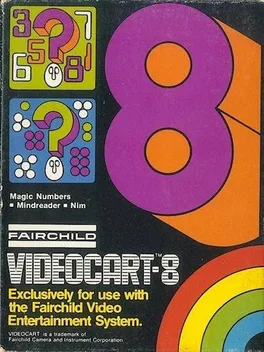
Mind Reader is a one-player game, you against the computer. The object is to guess the number the computer is thinking of. The number can be 2 to 5 digits long. You have 20 guesses or a time limit. Also in Nim you play against the computer. You have a choice of 3, 6, or 9 piles. The objects in the piles are numbers, 1 to 15. The player who takes the last number off the screen wins.
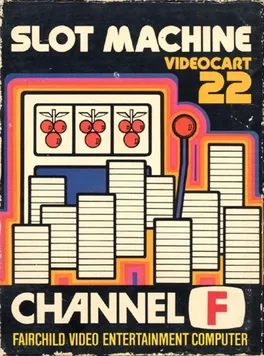
In this slot machine simulation, the player can choose the starting purse (from 1-99 USD) and then bet on each spin of the slot reels. The game offers two modes: Random play lets the wheel spin and then stop randomly, and select play lets the player choose when to stop each wheel at a time.