
Wonderland


Buy
Could be interesting

Just when a man thinks his luck is running out, things start getting even worse. He gets run over by a bus. Sprayed with cheese sandwich by a supernatural being. Smashed against a tunnel by a speeding train. He gets incinerated, widdled on, folded, bent, spindled, mutilated and generally mucked about with. And in return? He gets the leading role in a perplexing, hilarious race against time and chance, set in a jinxed land menaced by the impending death of good fortune. Look on the bright side - it could be your luckiest move yet. Don't expect tiresome trolls, obvious orcs, silly spells and wet, wimpish witches in JINXTER. Infuriating, enchanting, absurd and hilarious by turns, JINXTER will surprise you with every move you make. But don't forget: every silver lining has a cloud.
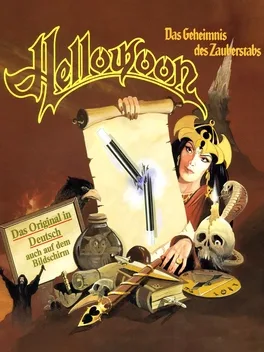

The aim of this interactive fiction with graphics is to escape from the land of Kerovnia, where strange occurrences are routine. The Roobikyoub dwarves have been banished from the kingdom, which is not good as they produce high-quality whisky. King Erik is not popular for this decision, as some feel that ale brewers and mineral water bottlers have influenced him. Honest John the trader and Kronos the Magician play a key role in your journey, each offering sub-quests to attempt. The package includes a novella complete with map and decipherable hints, which are accessed by typing 'hint' followed by the code into the computer. Therefore, those with only a pirated copy would struggle to complete the game. Your score and the number of locations visited are both displayed in the title bar. The parser allows whole words to be deleted and unaccepted previous entries to be re-edited.

Fantasy Interactive Fiction created by Andrew Plotkin, as both a game and an introduction to the genre.
Zork is one of the earliest interactive fiction computer games, with roots drawn from the original genre game, Colossal Cave Adventure. The first version of Zork was written in 1977–1979 using the MDL programming language on a DEC PDP-10 computer.

Niko: Through The Dream is a minimalist adventure accompanying Niko in her return to her world. We will travel through different islands, each of them being the oneiric representation of an important event of her past. Happiness, solitude or fear melted with hidden riddles, you will face up dangers and traps and, with Niko, you will confront them with determination, ability and logic. Playability intends to be direct and varied. Each island has a setting and mechanic of its own. Puzzles, riddles, platforms, stealth and exploration are the ingredients of the adventure. Prepare to start a journey which you’ll never know what hides ahead. A journey whose paths must be wisely chosen. Challenges you must face are based on different colors, shapes and sounds. Sometimes you can notice how game mechanics intertwined, being necessary to pay full attention if you want to advance in Niko’s journey. Music will evolve along with Niko, from happy and vivid melodies to sad and dark ones, the same way as the journey does. Music and sounds are key elements to stimulate both imagination and mood of the player. Don’t just play, feel the adventure as yours. The narrative develops as symbols and little tales deep within the scenario. We must explore it by ourselves to discover every detail of this fascinating adventure, fathoming the mysteries of Niko’s tale.
Beyond Zork: The Coconut of Quendor is an interactive fiction computer game written by Brian Moriarty and released by Infocom in 1987. It was one of the last games in Infocom's Zork series It signified a notable departure from the standard format of Infocom's earlier games which relied purely on text and puzzle-solving: among other features, Beyond Zork incorporated an on-screen map, the use of character statistics and levels, and RPG combat elements. The game, Infocom's twenty-ninth, was available on the Amiga (512kb), Apple (128kb), Atari ST, Commodore 128, and IBM (192kb), and the Macintosh (512kb) computers The player explores the Southlands of Quendor somewhat aimlessly at first. Soon, however, a task is bestowed by the Implementors, a group of godlike creatures jokingly based on Infocom's game designers. The Coconut of Quendor, an incredibly powerful artifact that embodies the whole of Magic, has fallen into the claws of an unspeakably foul beast: an Ur-grue. Rumoured to be the spirits of fallen Implementors, Ur-Grues can surround themselves in a sphere of darkness that only sunlight can pierce. The player must recover the Coconut from this monster's grasp or face the unthinkable consequences.

Fallen London is a browser-based choose-your-own-adventure game set in "Fallen London", an alternative Victorian London with gothic overtones.
A train journey abruptly cut off. An enforced stay in a strange City. Intrigue, madmen, and growing sense of being watched... A work of interactive fiction by Emily Short.
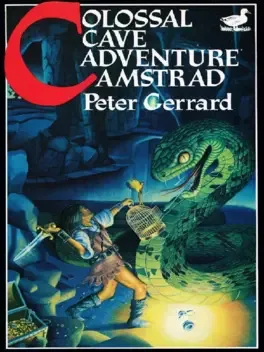
Colossal Cave Adventure is a text adventure game, developed originally in 1976, by Will Crowther for the PDP-10 mainframe. The game was expanded upon in 1977, with help from Don Woods, and other programmers created variations on the game and ports to other systems in the following years. In the game, the player controls a character through simple text commands to explore a cave rumored to be filled with wealth. Players earn predetermined points for acquiring treasure and escaping the cave alive, with the goal to earn the maximum amount of points offered. The concept bore out from Crowther's background as a caving enthusiast, with the game's cave structured loosely around the Mammoth Cave system in Kentucky.