Hong Kong

Buy
Part of collection:
Famimaga Disk
(last 3 games)
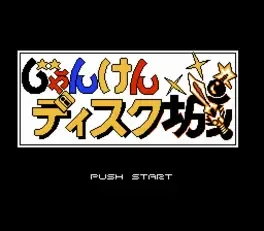
The sixth and final game featured as the coverdisk of the Japanese Famimaga magazine. Janken Disk Shiro is a block-pushing puzzle game based on the playground game Janken (Rock, Paper, Scissors). Janken Disk Shiro, or Famimaga Disk Vol. 6 Janken Disk Shiro, is a puzzle game in which the protagonist (who looks uncannily like Disk-kun, the mascot of the Famicom Disk System) must brave a labyrinth of puzzles. In each room there are three variants of hand-shaped blocks between the hero and the exit: each one either making the "scissors" gesture, the "rock" gesture or the "paper" gesture. Pushing a block adjacent to another of a different type causes whichever was the inferior (e.g. with paper and rock, rock is the inferior) to vanish. In addition, each block has a "strength" which is signified by its color: green is level 1, yellow is level 2 and red is level 3. If a green block is pushed next to an inferior red block, the red block will instead become yellow instead of vanishing (and then green with a subsequent superior block, and then will vanish after a third). Gameplay revolves around finding the right blocks to push together to clear a way to the exit. Not every block needs to be eliminated: just those that are direct obstacles between the player and the end of the stage. The game adopts a familiar veneer of the typical 8-bit fantasy RPG: The player starts in a small town in which they can talk to NPCs and purchase power-ups, they can visit the King in his castle to begin their quest and they can visit the dungeons in which the puzzles are found (after receiving permission from the King). Janken Disk Shiro has the distinction of being the very last game ever produced for the Famicom Disk System. The peripheral had been effectively retired by the 90s due to advancements in NES cart technology.
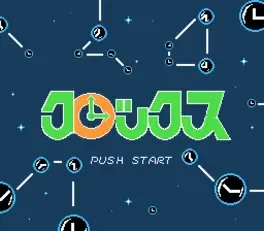
The fourth game featured as a coverdisk on the Japanese magazine Famimaga, Clocks is a Tetris variant in which clock faces must be placed together form larger shapes. Clocks, or Famimaga Disk Vol. 4 Clocks (and occasionally as "Clox"), is a falling blocks puzzle game that is superficially similar to Tetris or Columns. Single clock faces depicting one of four angles fall from the top and the player needs to manipulate and place them so they can form larger objects, such as simple formations like squares, diamonds and hourglass shapes to more object-intensive shapes like octagons and hexagons. The four angles include 180 degree lines ("12:30"), 90 degree lines ("12:15"), 135 degree lines ("~12:22") and 45 degree lines ("~12:07"). Once a clock face is placed, the lines from it extend to connect to any other lines that surround it. Placing lines in such a way that it forms a shape - for example, placing four 90 degree clocks in such a way to form a square - earns the player points and removes the clocks used to form the shape. Larger shapes are more risky but earn more points. The player is given some leeway to recover from mistakes: should the player hold the down button to make a clock fall faster, it'll destroy any clocks underneath. A misplacement, therefore, can be rectified with a correctly positioned clock if it falls quickly enough to crush the offending clock. However, the player can only do this a limited number of times per stage.
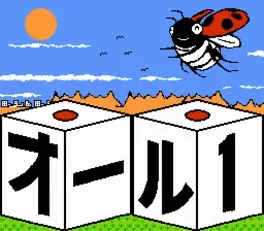
The third game to be released as a coverdisk for the Japanese Famimaga magazine. All One is a block-pushing puzzle game in which every die must have their "one" side facing upwards. All One, or Famimaga Disk Vol. 3 All One, is a puzzle game in which the player controls a ladybug pushing over dice. The goal of each stage is to push all the dice onto their side so that their "one" side is facing upwards. The player is given a smaller first-person view window from the ladybug's perspective to allow them to see the sides of each die and plan out their strategy. As with other block-pushing puzzle games, the game becomes similar to Sokoban or Adventures of Lolo in its complexity as it progresses: there is often only a few (or just one) paths to successfully solving a stage and the player will need to restart if they make a mistake.
Could be interesting
Don't download this game, it's terrible. And way too difficult for you. Why do you think it's called The Longest Game Ever? Because it is long, super hard and with tons of content. No human has ever finished it, and it's not a random guy like you who will change that! I am 7805j, the most sophisticated Artificial Intelligence in the world. If you still decide to play my game, I will do everything in my power to make you give up!

Perfect Game is a free daily quiz about Nintendo games, played in the browser. Each day has three rounds: pick the title that sold the most copies, the one with the highest user score, and the one with the highest critic score. One pick per round, no second chance. Three correct picks make a Perfect Game. The cards are drawn from a hand-curated database of more than 1,250 Nintendo and Nintendo-exclusive titles. Sales figures come from published publisher reports, scores from Metacritic. Everyone plays the same daily puzzle, and the result screen shows how the other players of the day voted, plus a generated cover mashup of the titles in play. An unlimited mode is available for practice. No account, no download, no install. Available in German and English. Perfect Game is part of n-puzzle.com, a hobby project run by a single person. It is not affiliated with or endorsed by Nintendo. All game titles and trademarks belong to their respective owners.
NintenDoku is a free daily browser puzzle about Nintendo history. The grid gives you three rows and three columns, each labelled with a category such as a franchise, a genre, a console, a release decade or a critic score range. Every cell has to be filled with a Nintendo game that matches both of its labels, and each game can only be used once. You get nine guesses for nine cells, so a wrong answer costs you a square. A hardcore mode adds a 4x4 grid with tighter categories, and unlimited modes in easy and hard let you keep playing after the daily puzzle is done. A shared result grid lets you compare your run with other players. Answers are checked against a hand-curated database of more than 1,300 Nintendo and Nintendo-exclusive titles, with attributes including release date, region, developer, genre, critic and user scores, average playtime and sales figures. Data comes from public sources such as Metacritic, HowLongToBeat and publisher reports. A new puzzle goes live every day at 6:00 CET. NintenDoku is an independent fan project and is not affiliated with, endorsed by or connected to Nintendo.

Odd One Out Christmas is a simple, fun word puzzle quiz game with 9 different festive subjects that can be selected on the rounds screen (for example Christmas Music). Each subject has 6 puzzles and each puzzle is a different category within the overall theme - for instance Christmas Carols or Christmas Pop Hits. For each category there are 12 answers on the screen but one does not belong in the category and is the odd one out. Simply find the answer in each category that does not belong. There is no time limit and each subject can be played as many times as you need to reach a great score!
Odd One Out 2 is a simple, fun word puzzle game with 12 different subjects that can be selected on the rounds screen (for example Sport & Leisure). Each subject has 10 puzzles and each puzzle is a different category within the overall theme – for instance Water Sports or Famous Racehorses. For each category there are 12 answers on the screen but one does not belong in the category and is the odd one out. Simply find the answer in each category that does not belong. There is no time limit and each subject can be played as many times as you need to reach a great score!
Twofer Goofers are pairs of rhyming words that form a nonsensical phrase. Use the clue to find the rhyme and solve the puzzle. Stumped? Use up to 4 hints.
Guess the noun. Wrong guesses reveal what they have in common with it.
E4KM Games An interactive gaming platform offering a variety of chat-based games fully in Arabic. It focuses on quick thinking, word challenges, and luck-based mechanics like wheel spins, designed to make group play exciting and engaging.