Galaxy Robo




Buy
Could be interesting

Live A Live's story is split across seven seemingly unrelated chapters that can be played in any order, based on popular genres such as Western, science fiction, and mecha. Each chapter has its own plot, setting, and characters. Although the basic gameplay is the same throughout the game, each chapter adds a new factor to the basic formula, such as the stealth elements in the ninja chapter. After the first seven chapters are completed, two final chapters take place to establish the connection between the seven previous and resolve the story.

In this simulation/role-playing game, you must use the robotic pixie Tinker to educate a robot boy named Pino. You can move Tinker around, examining objects and collecting them in an adventure-like fashion. Pino will automatically follow you to the direction you are facing, but will continue walking until you stop him. He will also pick objects and make his own "experiments" with them. Your goal is to train Pino in various disciplines. His stats can be raised in a RPG style: reading books increases his intelligence, throwing a ball increases his dexterity, and so on. By praising or scolding Pino you will gradually make him understand what should be done and what not. The game features animations by Anime studios Mint and Omnibus Promotions. With direction from Takashi Yoneda and late anime director Umanosuke Iida.

Power of the Hired is a strategy RPG for the Super Famicom developed and published by NCS's video game division Masaya. It was released exclusively in Japan in late 1994. The game features four player-named heroes that the player must use to fight off overwhelming waves of enemies. The primary character of the group is able to summon creatures to defend herself and the other party members, and through these creatures the player is able to tactically conquer each of the game's scenarios. Depending on the creatures summoned, the player characters' magic can change their elemental composition. Several scenarios requires that the player act quickly to avoid catastrophe, such as a burning bridge the player characters are stuck on that they need to quickly vacate.

Only released in Japan.
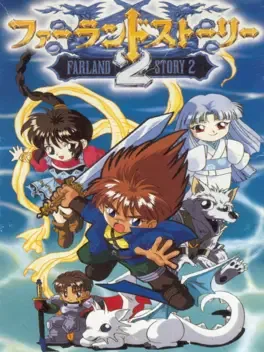
Farland Story 2 is an independent side-story to the Farland Story series (this game shouldn't be confused with Farland Story Denki: Arc Ou no Ensei, which is also known as "Farland Story 2"). The game is set in the same time line as the second and the third "mainstream" Farland Story games, 20 years after Arc has become a king. Peace has returned to the world, but on the continent of Ionia, an emperor is plotting an evil scheme. His son Riad refuses to accept the methods of his father, especially when he wants to use Serena, a girl he loves, for his plans of war and conquest. During a quarrel, Riad attacks the emperor's minister, and is forced to flee the castle together with Serena. The adventure of the runaway prince begins... Graphically and gameplay-wise, the game is similar to other Farland Story games, although its setting is generally more dark. The game consists of large strategic battles, during which you move your party over the battle location, attacking enemies physically when they are in range of your weapons, and casting healing and offensive magic. Like in other Farland Story games, the death of the main character (Riad in this case) means instant Game Over.
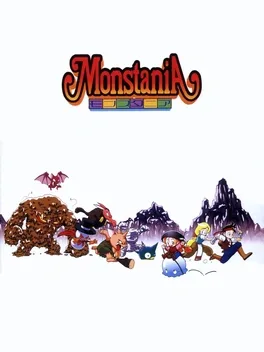
The hero of the game is Fron, a sixteen-year old boy who lives on the island of Monstania. One day, strolling in the forest, he notices a strange light. The light lead him to a clearing, and then suddenly disappeared. But Fron realized what was the meaning of that light - it was a fairy! Of course, everybody knew that fairies had been long extinct, but Fron never believed in that. All his life he wanted to meet a real fairy, and now, when the opportunity has come, he firmly decides to find her. His girlfriend Tia helps him on the dangerous journey, during which they meet a mysterious little girl named Chitta, and get involved in a grand adventure, that will ultimately lead them to the battle against the dark force that threatens the whole Monstania! "Monstania" has a somewhat unusual gameplay within the frames of console RPGs. You don't explore the world in the game: it is entirely linear and takes you to the next destination by itself (only at a few points you can choose where to go next by selecting an appropriate answer). Once within the location, you cannot leave it until you complete all your objectives there, which then take you to the next location. The objective is usually a large strategic battle. You navigate your party members on the battle field, attack with melee and long-ranged weapons, and use special technique which require action points. Unlike most other turn-based strategy games, an enemy makes a move immediately after you did the same with one of your characters, without waiting for the "enemy turn". The RPG element is not very significant: your characters level up automatically after each battle. There are also some puzzles to solve in certain locations.

Dai-4-ji Super Robot Taisen is a Sci-Fi Turn-Based Strategy game, developed and published by Banpresto, which was released in Japan in 1995.
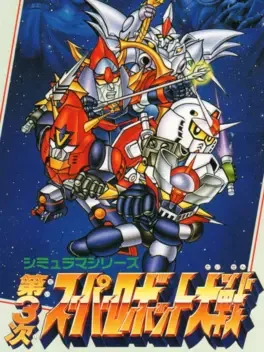
Dai-3-ji Super Robot Taisen ("3rd Super Robot Wars") is the third game in Banpresto's immense Super Robot Wars/Taisen series.Six months after the DC War (as chronicled in Super Robot Wars 2), the DC seems to be regaining their former combat strength thanks to the Zabi family. In response, the United Nations has decided to reorganize itself into the Earth Federation.
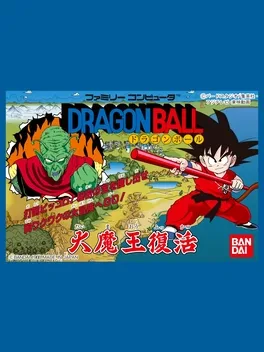
Dragon Ball: Daimaou Fukkatsu is a role playing video game released only in Japan by Bandai on August 12, 1988. It is the second Dragon Ball video game released for the Nintendo Famicom. Daimaō Fukkatsu is the first role playing game based on the Dragon Ball series. Its gameplay was reused in the Goku-den video game series. Daimaou Fukkatsu is also one of the games included in the game compilation J Legend Retsuden for Nintendo 3DS.